
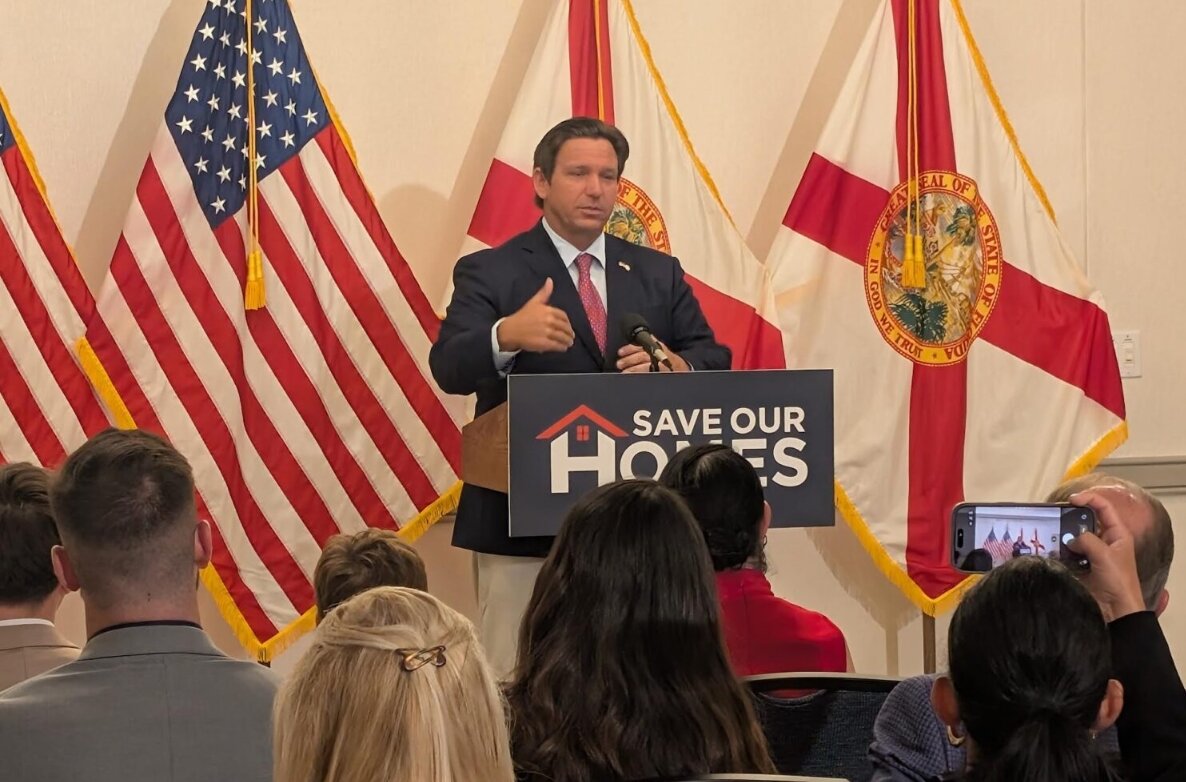
TAMPA — Gov. Ron DeSantis on Wednesday announced his plan for a homestead property tax exemption that could crimp local governments’ ability to fund schools, health care, and public safety.
Simultaneously, he called for lawmakers to return to Tallahassee and address his plan in a three-day special session starting Monday.
DeSantis has been discussing elimination of all property taxes for more than a year, although he eventually narrowed his plan to elimination of homestead property taxes only.
Despite the lengthy build-up, he provided few details other than a one-page summary, noting he still wants to “ensure funding for core services.”
The governor rejected tax proposals offered by the Florida House earlier this year. He said his plan — which would require three-fifth approval from both the House and Senate and then 60% approval by Floridians as a proposed constitutional amendment in November — would immediately eliminate property taxes for 60% of Florida homeowners.
The governor said he wants to increase the state’s existing homestead exemption to $250,000. The plan calls for the exemption to increase to $500,000 but would leave that decision up to the Legislature.
A Florida Office of Economic and Demographic Research report shows that 28% of homestead parcels in Florida have a median value of $250,000 or less and could immediately benefit from the property tax exemption if passed. Once raised to $500,000, 76% of the homestead parcels would qualify for the full exemption.

According to Redfin, the median sale price for a home in Florida in March was $416,800.
DeSantis’ proposal would require any individual who establishes Florida residency after Jan. 1, 2027, to maintain it for five years before receiving the increased homestead exemption. It would change the limit on future property tax assessments on small businesses from 10% to 5%.
This would be the third special session since the regular legislative session ended in March. The Legislature is required to annually meet for 60 days.
“We need to start standing up for taxpayers,” DeSantis said.
“For all this time, as we’ve seen inflation throughout the country, all these different things, it’s always the individual, the consumer, the taxpayer that’s expected to change things in order to make ends meet. They never expect government to be able to change things that so that it can benefit the taxpayers,” he continued.
“We’ve always focused on the homestead part of it, which, again, is less money than local governments get from residential properties that are not homestead, so that is something that’s doable and it’s something that’s really, really meaningful.”
Local governments pay nearly half of school funding. Property taxes contribute much of the local government contribution to schools. A local government’s share of the contribution to education funding depends on property values and taxes levied on those properties.

House Democratic leader Fentrice Driskell voiced concern about what the proposal could mean for schools.
“My mom is a retired educator, I hang out with a lot of teachers. I think there’s a reason why the governor didn’t want to show his work today,” Driskell said during a news conference at the Capitol Wednesday.
DeSantis, Driskell said, contradicted himself. “He says he wants to ensure funding for core services, and he says that that includes education. So, he wants to ensure that there’s funding, but there’s nothing in his plan that says that that funding won’t be cut.”
She added: “I’m very concerned that it could mean reduced funding for our schools overall, even though there could be some core service funding for core services that might maintain, but he hasn’t explained exactly what that would look like or how much there would be.”
The Florida Chamber of Commerce said in a written statement that it would “evaluate the proposed constitutional amendment with our members once specific bill text and potential fiscal impacts are released.” The pro-business lobby did note that “property taxes accounted for nearly $60 billion in local government and school funding in 2025, up from $55.18 billion the year prior and $35.7 billion in 2019.”
Florida requires counties to contribute to the state’s costs of the basic Medicaid program. What a county contributes varies depending on its share of Medicaid enrollment. That amount is calculated annually and adjusted through changes in Medicaid expenditures. Documents show that counties in 2025 contributed $411.6 million toward the Medicaid program in FY 26-27. Economists predict that number will increase to $438.4 million in FY 27-28.
Moreover, some counties contain hospital taxing districts, which also are supported by local property taxes. Large hospital systems, such as Broward Health, Memorial Health Care, and Hallifax Health, are run by taxing districts that rely on property taxes.
Senate President Ben Albritton publicly released a statement following the press conference showing he is all in on the governor’s proposal.
“Since the Governor first introduced this issue, my goal has been for the Senate to pass an amendment that gives voters the opportunity to reduce their property taxes in a straightforward and substantial way,” Albritton said.
“In my view, the proposal the Governor explained today does that. I can’t think of a more meaningful way to celebrate America’s 250 then the passage of $250,000 in tax relief for every Florida homeowner. I believe this amendment will provide meaningful relief for Florida families, while protecting businesses from extreme tax increases and safeguarding local funding for public safety, education and our clean water infrastructure.”
The Senate during the 2026 regular session never considered property tax relief. By contrast the House passed a proposal offered by Rep. Monique Miller, R-Palm Bay, that would have completely ended non-school property taxes by Jan. 1, 2027.
“We are pleased the Governor has finally gotten around to share an actual proposal,” House Speaker Daniel Perez said in a statement, according to the Tampa Bay Times. “We look forward to reviewing it once we have received the language.”
There’s no definition of “core services” in the one-page summary but they “include” public safety, education, infrastructure, and natural resources, he said.
But to ensure core services continue to get funded by county governments DeSantis proposes a new trust fund be developed.
“We are creating a trust fund in state government that will be able to provide grants to local governments for support for these core services,” he said, referring to law enforcement and education. Some counties wouldn’t need such support, he added, referring specifically to Palm Beach County.
Such a trust fund would be established following the November election by the Legislature and his office if the measure passes, he said.
Public opinion surveys have been mixed about whether Floridians would approve a constitutional amendment on property tax relief. A University of North Florida poll released in March showed 56% of respondents expressing support with 35% opposed. The proposed measure could only become law if 60% of voters agree.
Florida Phoenix is part of States Newsroom, a nonprofit news network supported by grants and a coalition of donors as a 501c(3) public charity. Florida Phoenix maintains editorial independence. Contact Editor Michael Moline for questions: info@floridaphoenix.com.


4 comments on this item
Only paid subscribers can comment
Please log in to comment by clicking here.

rayfusco68
There is no such thing as a free lunch in politics. Either the effected programs will be drastically cut causing significant harm to healthcare, education, etc. or citizens will be taxed covertly through sales tax, or other forms of hidden taxation. This is just a major flimflam the Governor is trying to play on us.
Friday, May 29 Report this
Cat L
Considering desantis' push for privatization, this looks to me like a "covert" way of destabilizing systems so private providers can swoop in and "rescue" that system from the situation. And a trust fund controlled by an unethical governing body would be a control mechanism easily deployed when the governor doesn't like what they are doing. (It would be a shame if something to happen to your funding...... [in my best gangster voice])
Friday, May 29 Report this
pdsinc
This is just De Saintis announcing his run for president. His plan is to let developers off the hook for covering the impact to infrustructure which is already far behind that they have have created. Guess where the cost of the improvements will come from.
Friday, May 29 Report this
san.gander
Irresponsible Ron... Property taxes pave the roads, dig the sewers and drains for flood control, pay for clean tap water you drink and cook with and much more! Tax money pays the electric bills for all those traffic lights you love to hate but need, and for the firefighters, police, and the public or private companies that pick up the trash! That's only going to grow in need as Florida's population continues to grow! Everyboby can plainly see that. How stupid is our govenor. If you can afford to pay big money for a house, you can afford to pay taxes to keep the streets paved and the street lights on and a friendly Firefighter or two on duty at the nearby fire station, in case your house is the path of burning scrub! PS It's the local folks who know what is needed in their community... not politicians in Tallahassee... return tax money, and authority, to local couny and city experts for better targeted use!
Friday, May 29 Report this