

On Aug. 16, 1858, Queen Victoria sent a message to President James Buchanan through a telegraph cable stretched beneath the Atlantic Ocean. For the first time, a message could cross an ocean faster than the ship carrying the news.
Down in a tiny settlement along Florida's Manatee River, however, news still traveled at the speed of a horse if you were lucky enough to own one, or as fast as the wind could carry a schooner.
It would take another generation, a barn full of discarded copper fencing wire and a determined teenager to change that.
By then, the telegraph had transformed communication across much of the country, carrying news that once took days or weeks in a matter of minutes. But those wires had not yet reached the pioneer settlements along the Manatee River and farther south in Sarasota. To send a telegram beyond the region, the message first had to make its way to Tampa the old-fashioned way – by foot, buggy or boat.
On December 27, 1884, postmaster Charles Abbe was murdered on the beach by a group called the Sarasota Vigilantes. Those close to him needed to alert a relative in Chicago immediately, but the news took longer to get from Sarasota to Tampa than it did to get from Tampa to Chicago. The irony was remarkable: electricity could carry a message from Tampa to Chicago faster than a boat could carry one between regional towns.
The problem wasn't sending a message across the country. It was getting Manatee County connected to the wire.
As it happened, one Manatee County family had plenty of wire.
Hiram Wheeler Leffingwell, an early Ellenton pioneer, had brought a quantity of copper wire from St. Louis, intending to use it for fencing. Once here, however, he discovered his plan wasn't going to work.
So the wire was put away.
Decades later, Hiram's relative, Ora Cooper Leffingwell, remembered what happened to it in a 1973 oral history interview with Carl D. King.
"So that wire laid curled up in somebody's barn for years and years and years," she recalled.
What looked like the remains of an unsuccessful fencing project would eventually become something much more important.
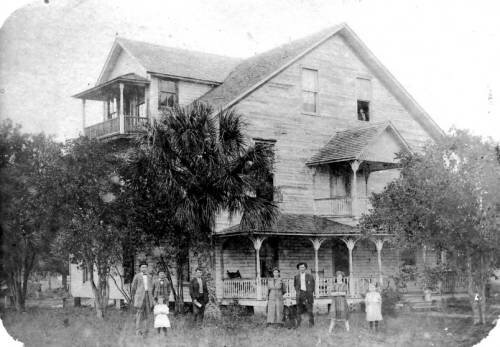
Hiram's son, Dr. John Brooks Leffingwell, was already experimenting with the possibilities of the telephone. According to Ora, the doctor established what she remembered as the first telephone in Manatee County, a private line connecting his office downtown on 13th, or Main Street, with his home at Point Pleasant. And his son Jack grew up fascinated by it.
Jack B. Leffingwell had an idea to modernize the sleepy town of Braidentown (former name of present-day Bradenton). He would use his grandfather's old copper fencing wire to connect with Tampa.
Jack didn't intend merely to experiment. According to Ora's recollections, he wanted to establish a telephone business between the two communities. So, he began stringing the old copper wire toward Tampa.
It is difficult today to appreciate what Tampa represented to residents of Manatee County at the turn of the 20th century. The communities were not terribly far apart on a map, but distance was measured differently when roads were primitive and transportation often depended on horses and boats. A direct communications line could make those miles disappear.
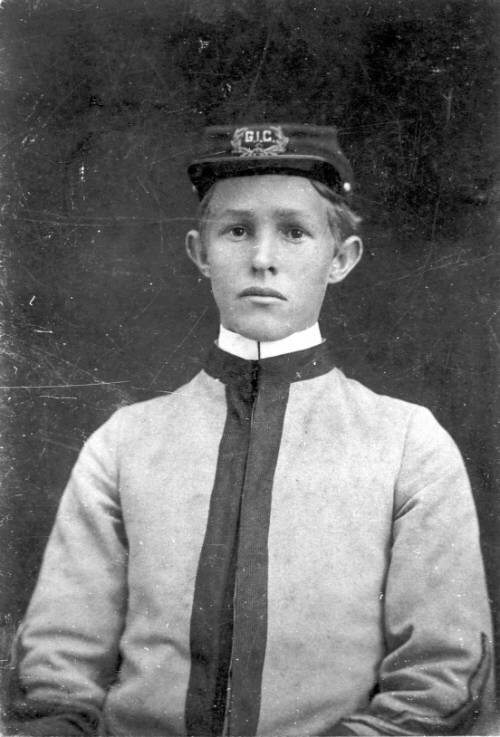
After working tirelessly stringing approximately 30 miles of copper along trees and poles between Palmetto and Tampa, Jack encountered a problem no amount of copper wire could solve.
A telephone company in Tampa held an exclusive franchise, preventing him from completing his planned connection. After all the work and all the ambition he had poured into the project, the teenager learned that his telephone business wasn't going to happen.
Ora remembered his reaction decades later.
He "just sat down and cried," she said.
But Jack's failed telephone line wasn't finished yet. A man named Alex Knight, who worked in a telegraph office, learned about Jack's predicament. A telegraph line was being installed simultaneously, Ora recalled, and Knight realized that Jack's existing copper wire could be used for it. It became part of the telegraph system.
Jack's telephone company failed but his wire served another purpose.
Eventually, telephone and telegraph communication shared a home in Bradenton.
A historic photograph preserved with the Leffingwell materials shows the city's first combined telephone and telegraph office in the old Warren Building.
At the center of the operation was the first 50-line switchboard installed in the county.
Early telephone communication depended on a human being sitting in front of a board filled with connections. A signal alerted the operator that someone wanted to make a call. A drop on the board indicated the line. The operator inserted a plug, learned whom the caller wanted and then used another cord to physically connect one person with another.
Every conversation depended on someone making the connection and those little bells represented an extraordinary change.
---
The first transatlantic cable of 1858 failed within weeks, but the idea behind it did not. The world had discovered that distance could be conquered by a wire.
Here along the Manatee River, that revolution survives in fragments: a telegram bearing a Tampa dateline, a photograph of operators beside a 50-line switchboard and the recollections of a woman who remembered a teenage boy devastated when his grand plan didn't work.
And, of course, there was the wire.
For years, it sat curled in a Manatee County barn, the remains of a fencing project that had gone nowhere.
Then a teenager looked at it and saw something entirely different.
He saw a way to reach the rest of the world.
Sources


Comments
No comments on this item
Only paid subscribers can comment
Please log in to comment by clicking here.