
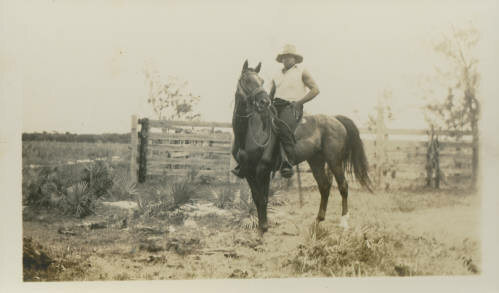
Archie Rutledge was born on August 11, 1913, one of ten children of Butch and Ella Rutledge in Gainesville, Florida. That same year, the Rutledge family relocated to Palmetto. At the time, educational opportunities for African American children in Florida were severely limited due to deep-seated racial segregation and inequality. Black students were restricted to separate schools—often privately funded and poorly resourced—where secondhand materials were the norm.
While Archie’s six sisters were encouraged to pursue schooling, he and his brothers left after the third grade to help support the family. At just 11 years old, Archie began working at Harrison’s Packing Plant, where his father secured him a job as a butcher. His primary task, as recorded in a 1980 interview by the Manatee County Historical Society, was skinning cattle in the slaughter pen.
By age 17, Archie had joined a cattle crew that roamed the woods collecting stray cows. It quickly became apparent that Archie had a special talent—an innate ability to manage horses, even the most skittish and untamed.
Not long after, Archie became a full-fledged cow hunter. In those days, Florida’s open range teemed with wild cattle. Ranchers and cowboys—aware of the rising demand for beef exports to Cuba—captured and processed these animals to earn a living. The work was arduous, but Archie relished the freedom it brought.
His mornings began well before daylight. Using a torch tethered to his horse for light, he prepared a quick meal while the horse ate from a feed bag. As dawn broke, he would saddle up and head into the vast prairies to round up cattle.
Archie earned one dollar per day, plus meals. In addition to hunting cattle, he often took on cooking duties, especially when the crew lacked a designated cook. He cooked while riding, hunting, and moving from site to site. Sundays were their only rest days.
Driving a weathered chuck wagon pulled by two mules, Archie traveled from camp to camp, preparing hearty meals over open fires made from “lighter knots”—resin-rich pine that burned hot and long. He set iron pots and a Dutch oven on bricks over the glowing embers and served biscuits with every meal. On holidays like Thanksgiving, the crew would pool funds to buy a turkey, which Archie would cook with rice to make perlou. These communal meals brought comfort to cowboys far from their families—when the only family was each other.
Cow hunting was not without danger. Stampedes were a constant threat, especially at night. Archie recalled encircling the herds with lighter-knot fires to deter the cattle from charging through fences. During the day, the strategy shifted to intercepting the herd, sometimes by driving them into ponds where the water would slow them down.
One harrowing incident nearly cost Archie his life. While riding into a pond on the Myakka flats, his horse bolted into a swamp, dragging him along. The accident left him with a broken collarbone, three fractured ribs, and numerous other injuries. Unconscious and stranded, he lay on a cot for days until help arrived and transported him to Myakka City. After a two-week recovery, Archie returned to work.
When World War II began, Archie was drafted and sent overseas. Upon his return, he spent time caring for his ailing mother until her death in 1952. He then resumed cattle ranching, only to face a new threat, screwworms.
Screwworm infestations, which left cattle with grotesque wounds filled with larvae, were devastating. The government introduced mandates for treatment: infected cows had to be dipped in insecticide vats. If they resisted, they were culled. It was during this time that Archie mastered the art of roping. Lassoing became a critical skill, allowing him to catch and treat infected cattle swiftly. Even after retirement, he kept a rope in his truck as a proud symbol of his lifelong trade.
In his late 60s, Archie shared his story with the Manatee County Historical Society. His life is a powerful testament to the perseverance, grit, and quiet heroism of African Americans in Florida’s early cattle ranching days. Despite facing systemic discrimination, physical hardship, and wartime trauma, Archie Rutledge remained deeply committed to his work and his community.


Comments
No comments on this item
Only paid subscribers can comment
Please log in to comment by clicking here.