

Along Florida’s nearly empty Atlantic shoreline, an occasional lighthouse guided ships away from danger. Between those distant lights stood another kind of beacon: a solitary wooden House of Refuge, occupied year-round by a keeper and his family.
By day, these houses welcomed visitors arriving by sailboat along what is now known as the Intracoastal Waterway. Travelers stopped for picnics, conversation and shelter from unfavorable weather. Yet inside, cots and provisions for as many as 25 people remained ready for a different kind of guest. Years might pass without a single shipwreck, but the keepers knew that one violent night could fill every bed.
At Gilbert’s Bar, located on Hutchinson Island near present-day Stuart, Fla., that night came in October 1904. A violent gale pushed the three-masted ship Georges Valentine toward the rocky shoreline. Rain fell in torrents, waves battered the coast and darkness swallowed nearly everything in sight. Inside the House of Refuge, Keeper William Rea kept a light burning, giving the sailors a faint beacon toward shore as their ship broke apart in the surf.
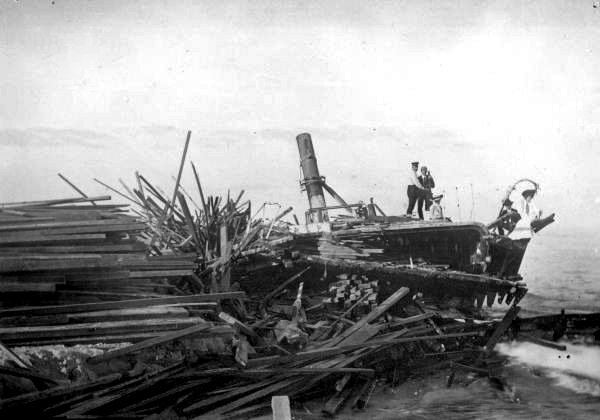
(Above) A couple stand near a shipwreck near Hutchinson Island's Gilbert's Bar House of Refuge - Stuart, Florida. 1890 (circa).1890 (circa). State Archives of Florida, Florida Memory.
One sailor reached land clinging to a piece of floating lumber. Cold, hungry and naked, he nevertheless returned to the wreckage to help rescue six of his crewmates. The sea had repeatedly thrown the men against the rocks and scattered lumber. Some were so injured, that they could no longer stand when they were brought inside.
Rea spent the night searching the beach while pieces of lumber flew through the darkness and crashed around him with a sound the official wreck report compared to thousands of rifles. Five sailors were lost, but seven survived.
The following day, before Rea and his family had recovered, another ship appeared in distress. The Spanish vessel Cosme Colzado ran ashore approximately three miles away. Its 15 surviving sailors joined the seven men from the Georges Valentine, leaving the keeper and his family to clothe, feed and care for 22 shipwreck survivors. After years of waiting, nearly every emergency place inside Gilbert’s Bar was needed within two days, according to “Lonely Vigils: Houses of Refuge on Florida’s East Coast, 1876–1915” by Sandra Henderson Thurlow in The Florida Historical Quarterly.
Rea was one of many keepers enlisted in the U.S. Life-Saving Service to run Florida’s Houses of Refuge through a nationwide effort to reduce the staggering number of lives lost along America’s coastline. In 1871, Congress appropriated $200,000 to the Revenue Marine Bureau of the U.S. Treasury Department to establish the lifesaving system.
.jpg)
(Above) Biscayne House of Refuge - Miami Beach, Florida. 1924 (circa). State Archives of Florida, Florida Memory.
Florida presented an unusual challenge. Ships caught in storms frequently came close enough to shore for sailors to reach land. Survival, however, was far from guaranteed. Much of the Atlantic coastline remained virtually uninhabited, leaving castaways without food, fresh water, shelter or any way to summon help.
The first five Houses of Refuge were constructed in 1875 and entered service in 1876. Five more followed about a decade later. The U.S. Life-Saving Service was formally established in 1878, with Florida’s houses administered as part of its Seventh District. The service later merged with the Revenue Cutter Service in 1915 to create the U.S. Coast Guard, according to Thurlow.
The 10 Houses of Refuge stretched southward along Florida's east coast at Smith’s Creek, later known as Bulow; Mosquito Lagoon; Chester Shoal, north of Cape Canaveral; Cape Malabar; Indian River, later called Bethel Creek; Indian River Inlet near present-day Fort Pierce; Gilbert’s Bar near Stuart; Orange Grove near present-day Delray Beach; Fort Lauderdale; and Biscayne Bay near Miami Beach.
The map of the system also included the Jupiter Inlet Life-Saving Station, but it operated differently. Traditional lifesaving stations employed trained surfmen and maintained boats and rescue equipment. A House of Refuge was primarily intended to shelter sailors who had managed to reach land. Its keeper did not command a full rescue crew. Instead, he and his family maintained the station and searched the beach for castaways after storms.
Each house contained enough cots and provisions to care for 25 people for 10 days. Clothing and medicine were also kept for survivors who might arrive injured and with nothing more than what they were wearing. Wives cared for the clothing and often became, as one newspaper described them, both “housekeeper and mother” to the sailors who reached their doors.
The keepers were expected to live at their stations year-round, usually with their families. They recorded the weather and passing ships, maintained the buildings and supplies, and patrolled the beach after storms. Families were considered essential because they could assist during emergencies while helping ease the profound loneliness of the assignment.
Some stations were so isolated that, when asked how many men between the ages of 15 and 55 lived within three miles, at least two keepers answered, “None.” Obtaining provisions could require a journey of four to 24 miles. Families collected rainwater for drinking and endured hurricanes, illness and long stretches without visitors.
Yet the houses gradually became much more than emergency shelters. Before the railroad opened Florida’s east coast to development, sailboats were the primary means of transportation along the inland waterway. Travelers regularly stopped at the stations while cruising the route now known as the Intracoastal Waterway.
As settlements grew, Houses of Refuge became gathering places. Families arrived from the mainland for picnics and swimming parties. Travelers docked nearby, winter tourists brought lunches and guidebooks began listing the stations as points of interest.
The emergency supplies still had to remain ready for castaways. Some keepers supplemented their modest government salaries through farming, beekeeping, boat building or providing lodging separately. Charles Carlin, keeper of the Jupiter Inlet Life-Saving Station, and his family opened the Carlin House near the Jupiter Lighthouse. It became a popular hotel and boardinghouse for travelers.
By 1915, several facilities had already been deactivated. The remaining stations became part of the newly created U.S. Coast Guard and continued serving the coast in different capacities.
Of the 10 Houses of Refuge, only Gilbert’s Bar remains standing. The 1876 building is the oldest surviving structure in Martin County and now operates as a museum under the Historical Society of Martin County. The tower beside it was added during World War II, when the site was used to watch the ocean for German submarines and hostile aircraft.
Just offshore, remnants of the Georges Valentine still rest beneath the water approximately 100 yards from the house. The wreck is now a Florida Underwater Archaeological Preserve and is listed on the National Register of Historic Places.


1 comment on this item
Only paid subscribers can comment
Please log in to comment by clicking here.
serenowens
I'd like to recommend Tales of Old Florida published by Castle. Another is by J. K. Small, From Eden to Sahara, Florida's Tragedy. Both are about how Florida was viewed in the last decades of the 1800's.
Sunday, August 9 Report this