

This week in our “Lost but Not Forgotten” series, we’re highlighting a Sarasota landmark that has become almost invisible with time.
Shadowed by modern towers along South Palm Avenue, the surviving Mira Mar Hotel blends quietly among Mediterranean Revival storefronts and newer development. If you didn’t know its history, you might walk right past it without ever realizing you were passing a century-old building, one of the few surviving pieces of Sarasota’s roaring 1920s boom years.
Much of the original Mira Mar is gone. The grand hotel and auditorium that once defined Sarasota’s social scene disappeared decades ago, replaced by changing tastes and changing times. Yet part of the original apartment building still remains, offering a glimpse into an era when Sarasota first imagined itself as a glamorous Gulf Coast destination.
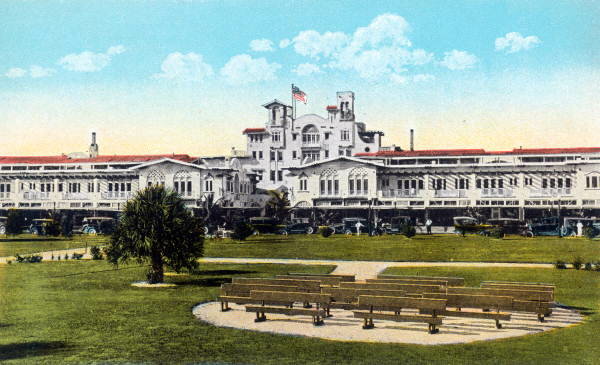
Constructed during Sarasota’s explosive land boom of the early 1920s, the Mira Mar Apartments-Hotel was one of the largest building projects the city had ever seen. Chicago industrialist Andrew McAnsh envisioned an elegant Mediterranean Revival destination overlooking Sarasota Bay, complete with luxury apartments, a hotel and an auditorium that would quickly become one of the city’s premier gathering places. The Sarasota County Times heralded the project as “the dawn of a new era in the city’s history of development.”
The project rose with astonishing speed. Construction began in October 1922, and within months the apartments, hotel and auditorium were taking shape along the bayfront. By January 1924, the Mira Mar Auditorium had opened as Sarasota’s premier civic and entertainment venue, hosting concerts, dances, lectures and community events.
During its golden years, the Mira Mar stood at the center of Sarasota society. Celebrities, athletes and dignitaries passed through its doors while the city marketed itself as an elegant tropical retreat on Florida’s west coast. Historic postcards preserved by the Sarasota County History Center described the property as:
“Sarasota’s palatial hostelry, the Miramar Hotel, overlooks the colorful waters of the Sarasota Bay, midst tropical gardens of many hues, presenting a scene of rare beauty.”
The postcards boasted of luxurious tropical patios, an open sun deck, superb dining and an “old-world Castilian dining room,” capturing the Mediterranean elegance Sarasota embraced during the boom years.
But like much of Florida, Sarasota changed after the boom faded.
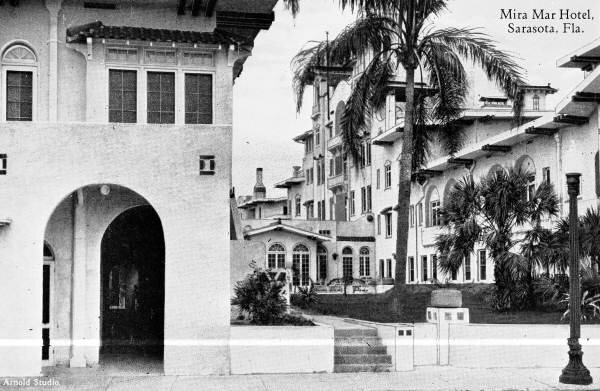
Following World War II, many of Florida’s grand boom-era hotels and luxury apartments struggled to compete with newer roadside motels, automobile-centered travel and modern air-conditioned accommodations. Across the state, aging resort properties were often transformed into apartments, retirement residences or seasonal housing as tourism patterns shifted and downtowns evolved.
The Mira Mar followed that same path.
By the mid-century years, the language used to market the property had changed as well. Another historic postcard described the Mira Mar as:
“One of the finest retirement hotels in the country, the distinguished hotel of Florida’s west coast…”
The glamour remained, but the audience had changed. What had once been a luxury destination hotel for Sarasota’s winter social season gradually evolved into a retirement residence as the city around it continued to grow and modernize.
The auditorium was eventually demolished in the 1950s, and the hotel itself later closed as travelers gravitated toward newer accommodations along US 41. Still, portions of the property adapted and survived. Later advertisements promoted the “Miramar Apartments and Shops” featuring furnished efficiencies, seasonal rentals and storefronts along Palm Avenue amd reflecting yet another chapter in the building’s long evolution.
Then, in 1982, much of the remaining hotel complex was demolished during redevelopment. Only the apartment block along Palm Avenue survived.
Today, the surviving structure looks very different than it did during Sarasota’s Golden Age. Surrounded by sleek high-rises and modern downtown development, the once-grand Mira Mar no longer dominates the skyline or Sarasota society pages. Instead, it quietly blends into the streetscape around it.
And perhaps that is what makes the Mira Mar such a fitting part of Sarasota’s “Lost but Not Forgotten” story.
Not every historic landmark vanishes all at once. Some slowly become part of the background. Some survive only in fragments. And some remain quietly standing in plain sight, waiting for someone to remember what they once were.


1 comment on this item
Only paid subscribers can comment
Please log in to comment by clicking here.
kmskepton
Thank you for writing about this.
Saturday, May 23 Report this